

As part of this project, CTI Systems was tasked with developing an On-Board Cargo Loader (OBCL) capable of loading and unloading oversized freight, while also being capable of being stowed aboard the aircraft itself. Only a limited number of airports possess the specialized ground equipment required to handle freight of this size.
Designed with its own built-in handling system, the OBCL eliminates the need for ground-based infrastructure. This autonomy streamlines cargo operations and opens access to airports that were previously inaccessible due to a lack of suitable equipment. The machine was engineered to handle a 23-ton payload, roughly three times its own weight.
Watch the video about this project:
The challenge: weight reduction without compromising performance
Because the OBCL had to be transported inside the aircraft, reducing its overall mass was a central design requirement.
CTI Systems identified the masts as a major opportunity for weight optimisation. Replacing the original metallic structure with carbon fiber reinforced polymer components offered the potential to reduce the machine’s weight by approximately 600 kilograms.
However, lightweight construction was only one part of the challenge. The composite structure also had to:
- Withstand the mechanical loads generated by a 23-tonne payload
- Comply with aviation-related airworthiness requirements
- Be developed and qualified within a highly constrained schedule.
A conventional development and qualification programme of this kind would normally have taken approximately 24 months. For the OBCL, Epsilon Composite and CTI Systems had to complete the development in just 9 months, while the technical specifications, load cases and qualification requirements were still evolving throughout the project.
This meant progressing simultaneously on requirements definition, material selection, mechanical design, manufacturing process development and qualification, while continuously adapting the solution as the project matured.
A hybrid composite solution
CTI Systems worked with Epsilon Composite on the design and manufacture of the OBCL’s carbon composite masts. Epsilon was responsible for the mechanical sizing of the composite beams, material selection and development of the manufacturing process, working closely with CTI Systems as the load cases and technical requirements evolved.
The solution combined pultruded carbon fiber profiles with prepreg reinforcements. Pultrusion was used for the main length of the masts, while prepreg was added in areas requiring specific geometries, local load introduction or additional reinforcement.
The resulting structure met the required mass and stiffness targets. Development, qualification and production of the first CFRP parts were completed within 9 months, compared with the approximately 24 months normally required for a programme of this kind.
As the project evolved, load cases and constraints also changed. The teams adapted the composite design and surrounding metallic interfaces without disrupting the overall schedule, keeping development aligned with the evolving requirements.
« Within a very short timeframe, we had to support the customer in defining the requirements, select the materials, mechanically design the beams, develop the manufacturing process, jointly define the qualification plan and finally manufacture the prototype parts, which were then qualified and delivered for entry into service.
At the beginning, meeting the requested schedule seemed extremely challenging. The team succeeded thanks to an efficient project organisation, considerable engineering ingenuity and very close technical cooperation between Epsilon, CTI and Airbus. Another key factor was our ability to build on materials previously qualified by Epsilon with Airbus for the A380 and A350 XWB programmes. »
Alexandre Lull, Managing Director
Integrating carbon and steel components
A key engineering focus of the project was the connection between the carbon composite beams and the system’s metallic structure.
CTI Systems adapted the steel interfaces to the specific behaviour of the composite parts, while Epsilon Composite contributed to the mechanical design of the interface areas and the definition and validation of the bonding approach between the two materials.
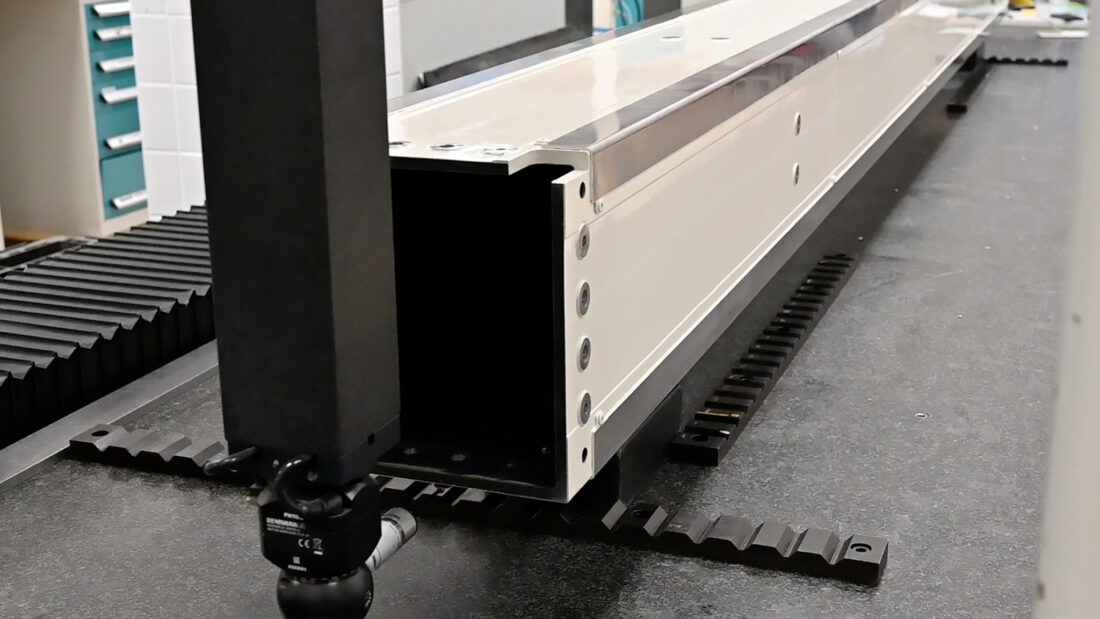
This interface work required careful attention to how loads were introduced and transferred between carbon and steel, as well as to differences in thermal expansion and material behaviour.
Epsilon’s scope extended beyond the manufacture of the composite profiles. The beams were delivered as finished components: precision-machined, inspected using ultrasonic non-destructive testing, and assembled with metallic parts and rails according to tight dimensional tolerances.
This required close control of the complete manufacturing and assembly process to ensure that the composite beams could be accurately integrated into the OBCL’s mechanical structure.
The project resulted in a lightweight composite mast structure adapted to the operational requirements of the OBCL, while meeting the project’s mechanical, temperature and non-flammability requirements.
Supporting the structure in service
The support continued after the composite masts entered service. Following an incident on the tarmac in which a vehicle struck the metallic structure attached to one of the composite beams, Epsilon was called in to urgently assess the condition of the structure.
Two field specialists travelled on site to perform a damage assessment using visual, ultrasonic and endoscopic inspection methods. The results were then reviewed by our engineering team to assess the condition of the composite structure and determine appropriate repair options.
This capability to combine field inspection, non-destructive testing and engineering analysis provides continued technical support for composite structures throughout their operational life.